Updated Election Risk Model
What we know after election day

In the previous post, I laid out a model of risk for an election being overturned. It was based on four factors.
Close Election
Republican Loss
Republican control of state
Grassroots mobilization
These factors suggested the highest risk elections were in Pennsylvania (1 close race), Georgia (1 close race), Arizona (2 close races), New Hampshire (1 race), Wisconsin (2 close races) and Oklahoma (1 close race). Michigan should also have been on this list because of the competitive gubernatorial election in a state with a republican-controlled legislature. On the bubble were Nevada, Oregon, and New Mexico which had close races but were in states with democratic control.
I suggested there were a couple of wildcards - whether disinformation elites would weigh in and whether there was really any legal wiggle room for an election to be overturned. I also pointed to a couple of caveats to generalizing to 2024, two of which we now know: if the election ended up being a red or blue wave.
Where are we now?
What races were close republican loses? Pennsylvania’s senate race may fit the bill, though the race may be on the edge. It’s unclear how close is close enough. Right now, 170,000 votes (3% point difference) separates the candidates. Pennsylvania’s governor’s race was probably not competitive enough (13 point difference) and is unlikely to be overturned. New Hampshire’s Senate race is also probably not close enough to be considered at risk. While it’s 40,000 votes of separation now, that’s a seven point lead. Finally, the Kansas Governor’s race is still too close to call but the incumbent democrat is likely to win. This was not on our radar as polls had the incumbent up by 5 points.
The Uncalled Races: Georgia’s Senate race is close but will likely go to a runoff because no candidate will receive 50% of the vote, so the risks in this election will likely get booted to December. Wisconsin presents an interesting case. While its senate race hasn’t been called, the republican has a small lead and is still likely to win. But, the democrat won the governorship in a somewhat close race (3 point difference). It’s difficult to say whether republicans would challenge the gubernatorial result but not the senate result. However, if the republican ultimately loses the senate seat, the risks of a push to overturn the election increase substantially.
Arizona: Yesterday, Arizona topped my list of at-risk elections because of the number of close races with plausible republican loses as well as a track record of legislators challenging the vote. This is on top of election deniers themselves being the ones running for office. Now, the day of the election has brought other risks into play 1) The troubles in Maricopa County became a leading story among the right in general and election deniers in particular and 2) the lack of a wave election means control of the senate could come down to Arizona. The more republicans lose their races for governor, senate, and secretary of state, the more likely we’ll see renewed pressure to overturn the election.
Low-risk elections: New Mexico’s gubernatorial race is a close republican loss but in a blue state. As such, it remains low-risk. However, elite focus could change this is in the coming weeks, especially if it’s neighbor Arizona begins challenging the integrity of its election. Nevada’s senate and gubernatorial races remain too close to call. While the state is led by democrats in the legislative and executive branches, the fact that the overall election was so close and the senate race may impact control of the U.S. congress, it is possible grassroots and elites may seek a judicial route to overturning the election if the republican loses the senate race.
No Waves: The lack of a red wave means the chance remains heightened that we will see a movement to overturn an election somewhere. While there wasn’t a blue wave nationally, democrats swept Michigan including both chambers of the state legislature providing an limited case where a set of elections might be challenged. The sweep was fairly large, so marquee races were not close. This would be a good test of how important the closeness of races is to whether they get challenged.
Surprises
Events Matter: One thing I didn’t account for was how unpredictable events like the issues with voting machines in Maricopa County could have on election denier mobilization. While there were several instances of voting issues in different districts, the Maricopa outage seems to have received substantially more coverage - 80,000 engagements according to the Election Integrity Partnership, compared to roughly 8,000 for issues with Detroit voters being turned away and 10,000 for printers running out of paper in Pennsylvania. Moreover, we didn’t see much disinformation targeting high-risk elections like Georgia, Nevada, or Wisconsin. Thus, while I argued that disinformation can be targeted at anything because it is unbound by truth, it seems there may be limits on what can be targeted.
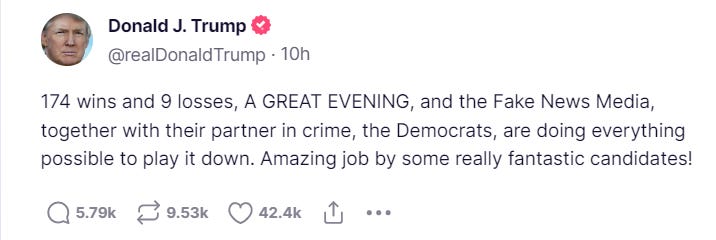
No one is denying an election yet: One thing that’s interesting and important to recognize is no one is denying an election yet, not even Trump. On Truth Social, he seems to endorse the current results, spinning the night as a victory. For all the bluster about unsecure elections, we’re just not seeing candidates challenge loses.
No Violence: One proposed predictor of an election being overturned was grassroots mobilization - will people pressure officials to overturn elections. One important component of this is violent mobilization. If people are willing to threaten officials, then the likelihood of an overturned election increases. I’ve only seen one report of violence thus far. As I’ll discuss later, there was a video circulating which claimed to show a poll worker filling in ballots. However, this does not appear to have led to violence, even though many believed it to be documented fraud and the (Inaccurately) reported location was published widely. This provides a substantial amount of optimism that risks of violence around elections are low.